
Looking for the Best Android Phone Under 25K? Here Are the Top Picks (2026)
My younger brother asked me to help him pick a phone last month, budget strictly Rs 25,000, and I ended up spending an entire Saturday comparing spec sheets across three different shops in Multan because the prices online almost never matched what the shopkeepers actually quoted. One shop had the same phone Rs 2,000 cheaper than Priceoye showed. Another was selling what they called “the same phone” with a slightly different chipset and nobody could explain why.
That whole experience is basically why I’m writing this. If you’re in this budget range in Pakistan right now, here’s what’s actually worth considering, based on what I found comparing specs, actual shop prices, and reviews from people who bought these phones.
One honest note before we start: phone prices in Pakistan shift week to week, sometimes even day to day depending on the dollar rate and import costs. Every price mentioned here is what I found as of writing this, but treat it as a ballpark, not gospel. Always confirm the current price at the shop or official store before paying.
How We Picked These Phones
I didn’t just grab the first five names that show up on a Google search. Here’s what I actually filtered for:
- Actually available in Pakistan with official warranty — not grey market imports with no local support
- Priced at or reasonably close to Rs 25,000 — a couple of these dip a bit under, giving you breathing room
- At least 4GB RAM or equivalent with virtual RAM extension — anything less struggles with WhatsApp, Facebook, and basic multitasking these days
- 5000mAh battery or close to it — non-negotiable at this price point, since battery life is what most budget buyers actually care about
- Decent display size and refresh rate — a lot of phones in this range now offer 120Hz, which genuinely changes how the phone feels day to day
- Real user reviews, not just marketing specs — I checked what actual buyers said held up over weeks of use, not just launch-day hype
Infinix Smart 9 HD — Full Review
This is the phone I’d point a first-time smartphone buyer toward, especially students who mainly need something for classes, WhatsApp, and social media without any fuss.
Price: Around Rs 22,000-23,000 Display: 6.7-inch IPS LCD, 720×1600, 120Hz refresh rate RAM/Storage: 4GB RAM, 64GB storage, expandable via microSD Camera: 13MP rear, 8MP front Battery: 5000mAh with 10W charging OS: Android 14 (Go edition)
What stands out here is the 120Hz display at this price, which honestly isn’t common. Scrolling through Instagram or switching apps feels noticeably smoother than phones without it. The battery easily gets you through a full day of moderate use.
The catch: 10W charging is slow. You’re looking at close to two hours for a full charge, which feels dated compared to some competitors offering 15-18W in the same price bracket. The camera is also strictly a daylight performer — low-light shots get noisy fast.
itel P65C — Full Review
itel doesn’t have the brand recognition of Samsung or Xiaomi here, but this specific model punches above its price tag in a few areas.
Price: Around Rs 22,000-25,000 (varies noticeably by retailer, so shop around) Display: 6.6 to 6.7-inch IPS LCD, 120Hz refresh rate RAM/Storage: 4GB RAM + 4GB virtual RAM, 128GB storage Camera: 13MP rear (some retailer listings show 50MP variants — confirm which camera sensor your specific unit has before buying), 8MP front Battery: 5000mAh with 18W fast charging OS: Android 13/14 (Go edition, varies by batch)
The 128GB storage is the real selling point here. At this price, most competitors give you 64GB, and that fills up fast once WhatsApp media and photos pile up. The 18W charging is also noticeably quicker than most phones in this range.
Worth flagging: itel’s camera specs listed across different retailers for this exact model are inconsistent — some list a single 13MP sensor, others list a 50MP main sensor. This isn’t me being sloppy, it’s genuinely how the listings look across Pakistani retailers right now. Ask the shop directly which sensor your specific unit has, and check the box specs in person before paying.
Samsung Galaxy A05 — Full Review
If brand trust and resale value matter to you more than squeezing out every spec, this is the one to go with.
Price: Around Rs 21,000-25,000 depending on retailer (4GB RAM/64GB variant) Display: 6.7-inch PLS LCD, 720×1600 RAM/Storage: 4GB RAM, 64GB storage (128GB/6GB variant available for a bit more) Camera: 50MP + 2MP rear, 8MP front Battery: 5000mAh with 25W fast charging OS: Android 13, One UI Core
Samsung’s biggest advantage here isn’t raw specs, it’s genuinely reliable software and long-term update support compared to lesser-known budget brands, plus a proper nationwide service network if anything goes wrong. The 25W fast charging is also the quickest in this comparison, getting you to 50% in about 35 minutes.
The downside: no fingerprint sensor on the base A05, only face unlock, which is noticeably less secure and doesn’t work great in low light. The display is also a standard 60Hz panel, so if you’ve gotten used to smoother scrolling on other budget phones, this will feel a step behind.
Tecno Spark Go 2 — Full Review
Tecno tends to fly under the radar in these comparisons, but the Spark Go 2 is worth cross-shopping against the Infinix Smart 9 HD directly, since they’re similarly specced.
Price: Around Rs 22,000-27,000 (multiple RAM variants exist — confirm you’re getting the 4GB version, not the cheaper 2GB or 3GB ones sold under the same name) Display: 6.67-inch IPS LCD, 720×1600, 120Hz refresh rate RAM/Storage: 4GB RAM, 64GB storage (128GB and 256GB variants also exist) Camera: 13MP rear with dual LED flash, 8MP front with dual LED flash Battery: 5000mAh
The dual LED flash on both the front and back camera is a small but genuinely useful touch for low-light selfies and video calls, something most competitors skip at this price. The 120Hz display also holds up well for everyday scrolling and casual gaming.
Important heads-up: Tecno sells this exact model name with 2GB, 3GB, and 4GB RAM variants at noticeably different prices, and retailers don’t always label this clearly online. If a listing looks unusually cheap compared to others in this article, it’s probably the lower-RAM version. Always ask the shop to confirm RAM and storage before paying, and check it matches the box.
Xiaomi Redmi A3x — Full Review
This is the pick if you want to stay comfortably under budget rather than stretching right up to Rs 25,000, and don’t mind a slightly more basic camera setup.
Price: Around Rs 19,000-20,000 Display: 6.74-inch IPS LCD, 720×1650, 90Hz refresh rate RAM/Storage: 3GB RAM (some listings show 6GB with virtual RAM extension), 64GB storage, expandable Camera: 8MP + 0.08MP rear, 5MP front Battery: 5000mAh
Xiaomi’s software experience and long-term reliability are genuinely a step up from lesser-known brands, and this leaves you roughly Rs 5,000 of headroom if you want to add a decent case, screen protector, and maybe a power bank without touching your main budget.
The trade-off is obvious: 3GB physical RAM is on the lower side even with virtual RAM extension helping out, and the camera setup is basic even by budget standards. If photography matters to you at all, this isn’t the pick. If you mainly need calls, WhatsApp, university portals, and light browsing, it’s genuinely solid value.
The trade-off is obvious: 3GB physical RAM is on the lower side even
with virtual RAM extension helping out, and the camera setup is basic
even by budget standards. If photography matters to you at all, this
isn’t the pick. If you mainly need calls, WhatsApp, university portals,
and light browsing, it’s genuinely solid value. Whichever phone you
end up buying, a few basic habits can keep it running smoothly for
years — I covered those in my guide on speeding up Android phones and
freeing up storage without deleting apps.
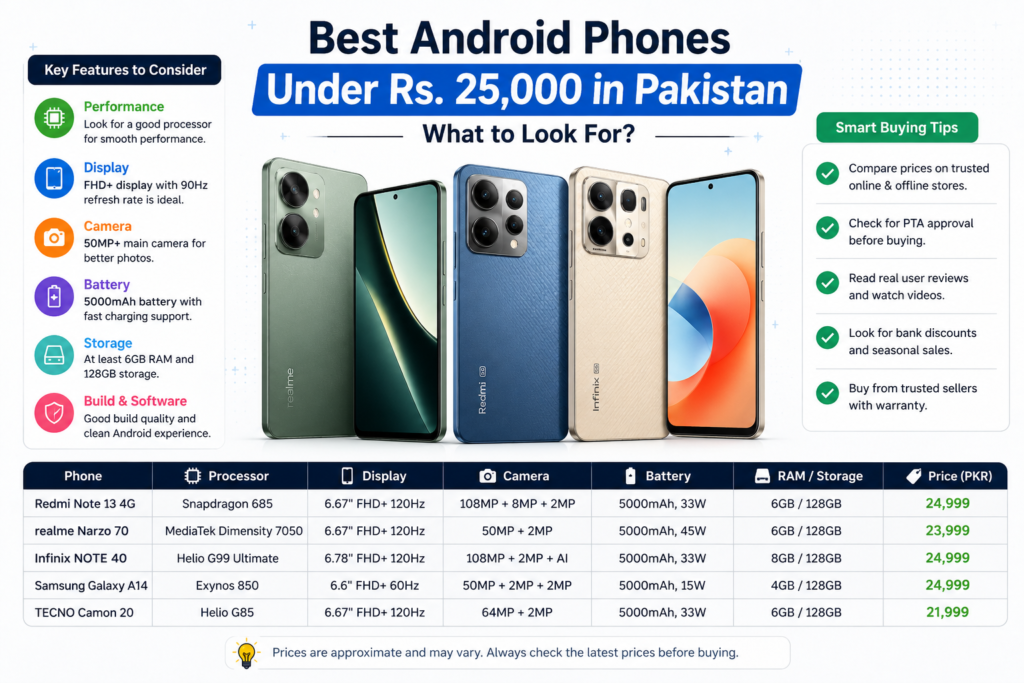
Comparison Table
| Phone | Price (approx) | RAM/Storage | Display | Battery | Best For |
|---|---|---|---|---|---|
| Infinix Smart 9 HD | Rs 22,000-23,000 | 4GB/64GB | 6.7″ 120Hz | 5000mAh, 10W | First-time buyers, smooth scrolling |
| itel P65C | Rs 22,000-25,000 | 4GB+4GB/128GB | 6.6-6.7″ 120Hz | 5000mAh, 18W | Storage-hungry users |
| Samsung Galaxy A05 | Rs 21,000-25,000 | 4GB/64GB | 6.7″ 60Hz | 5000mAh, 25W | Brand trust, resale value |
| Tecno Spark Go 2 (4GB) | Rs 22,000-27,000 | 4GB/64GB | 6.67″ 120Hz | 5000mAh | Low-light selfies, casual gaming |
| Redmi A3x | Rs 19,000-20,000 | 3GB/64GB | 6.74″ 90Hz | 5000mAh | Staying under budget |
Our Top Pick and Runner-Up
Top pick: itel P65C. The 128GB storage at this price point is hard to match, the 18W charging is genuinely fast for the segment, and once you confirm the camera sensor with your retailer, it’s a well-rounded phone for daily use, media consumption, and casual social media without constantly worrying about storage running out.
Runner-up: Samsung Galaxy A05. If you’re the type of buyer who values brand reliability, software updates, and knowing you can walk into any Samsung service center in the country if something breaks, this is worth the slight compromise on display refresh rate and fingerprint sensor. Resale value on Samsung devices also tends to hold up noticeably better than lesser-known brands when you eventually want to upgrade.
If you’re genuinely trying to spend as little as possible while staying reliable, the Redmi A3x is a smart fallback that frees up budget for accessories or a screen protector.
Where to Buy in Pakistan
For the safest buying experience:
- Official brand stores — Xiaomi has Mi Stores in major cities, Samsung has authorized dealers, and both offer proper warranty registration on the spot
- Priceoye, Daraz, and WhatMobile — useful for comparing prices across multiple sellers before you commit, though always cross-check the listed price against what a physical shop quotes
- Local authorized dealers — in cities like Lahore, Karachi, and Islamabad, established electronics markets (Hafeez Center in Lahore, Saddar in Karachi) have reputable shops, but stick to ones offering official brand warranty cards, not just a shop receipt
- Avoid unofficial/grey market imports unless you fully understand PTA registration — a phone that isn’t PTA-approved will lose network access on local SIMs after a limited window, and you’ll end up paying PTA tax anyway to keep it working
Before handing over payment anywhere, always ask to check the box, confirm the exact RAM/storage variant matches what’s advertised, and test the SIM slots, camera, and charging port on the spot. A five-minute check at the shop saves a lot of hassle later. Once you’ve got your new phone set up, it’s also worth securing your connection early —especially useful for students accessing university portals, which I covered in my comparison of the best free VPNs.