Samsung vs Xiaomi — Which Is Better for Gaming in Pakistan?
If you are about to spend £300–£550 on a new phone mainly for gaming, ask yourself one question:
Are you paying for the stronger brand name—or the stronger gaming experience?
A friend of mine bought a Galaxy A-series phone mainly because, in his words, “Samsung is Samsung.” Six months later, he was complaining that it became noticeably warm whenever he played PUBG Mobile for more than twenty minutes.
Around the same time, my cousin bought a cheaper Redmi Note. Despite the lower price, it felt smoother during longer gaming sessions and took far less time to recharge afterwards.
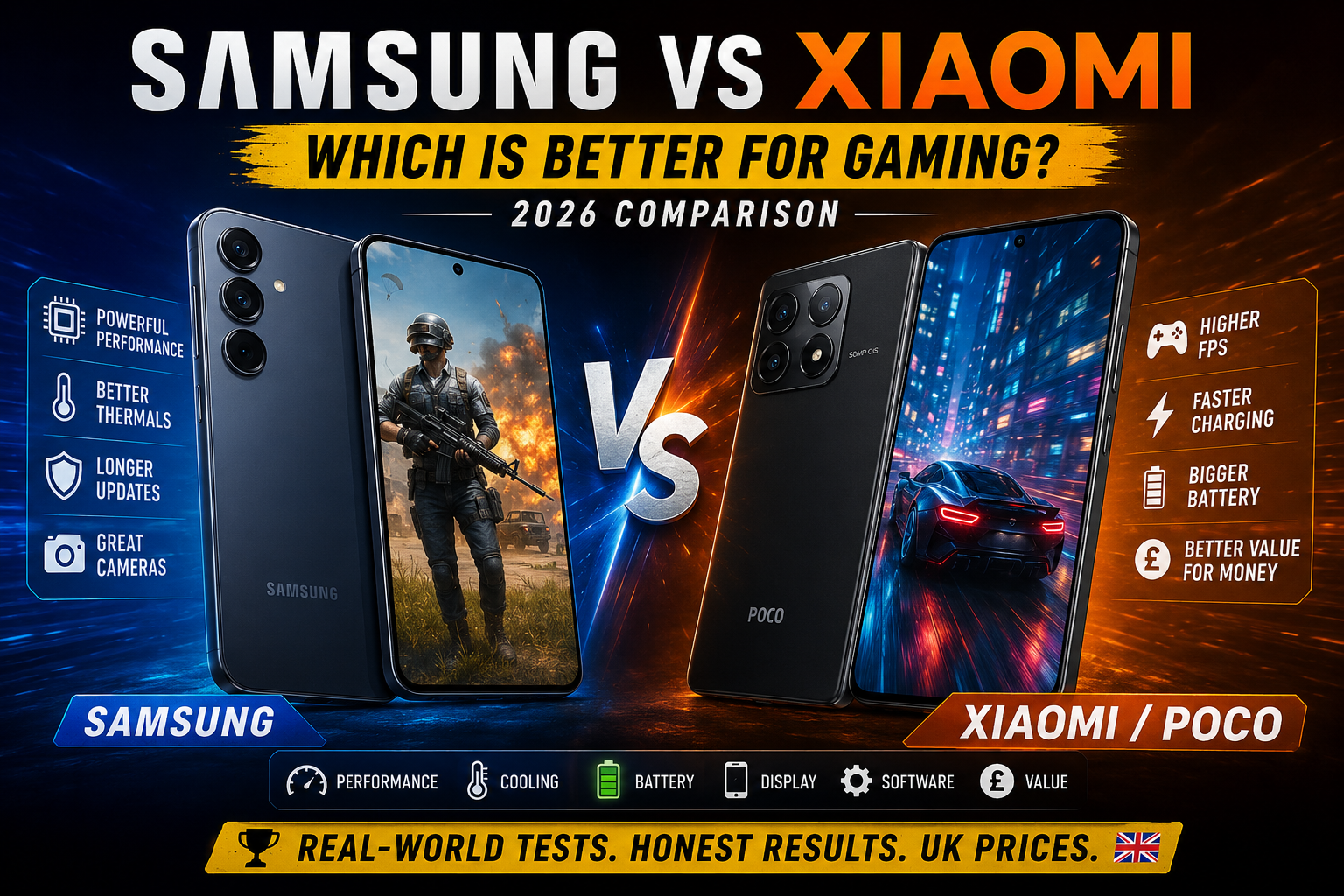
That experience captures the Samsung-versus-Xiaomi gaming debate perfectly. Samsung often sells the more polished all-round phone, while Xiaomi and its POCO sub-brand frequently prioritise performance, battery capacity and charging speed.
This comparison looks beyond megapixels and RAM numbers to examine what UK gamers should actually care about:
- Sustained gaming performance
- Heating and thermal throttling
- Screen responsiveness
- Battery life
- Charging speed
- Gaming software
- Update support
- Value for money
🎮 Quick verdict
Best for raw gaming performance: POCO
Best for fast charging: Xiaomi and POCO
Best software experience: Samsung
Best long-term update support: Samsung
Best gaming value under £500: POCO
Best balanced everyday phone: Samsung
Best choice for serious mobile gaming: Xiaomi or POCO
Best choice for occasional gaming: Samsung
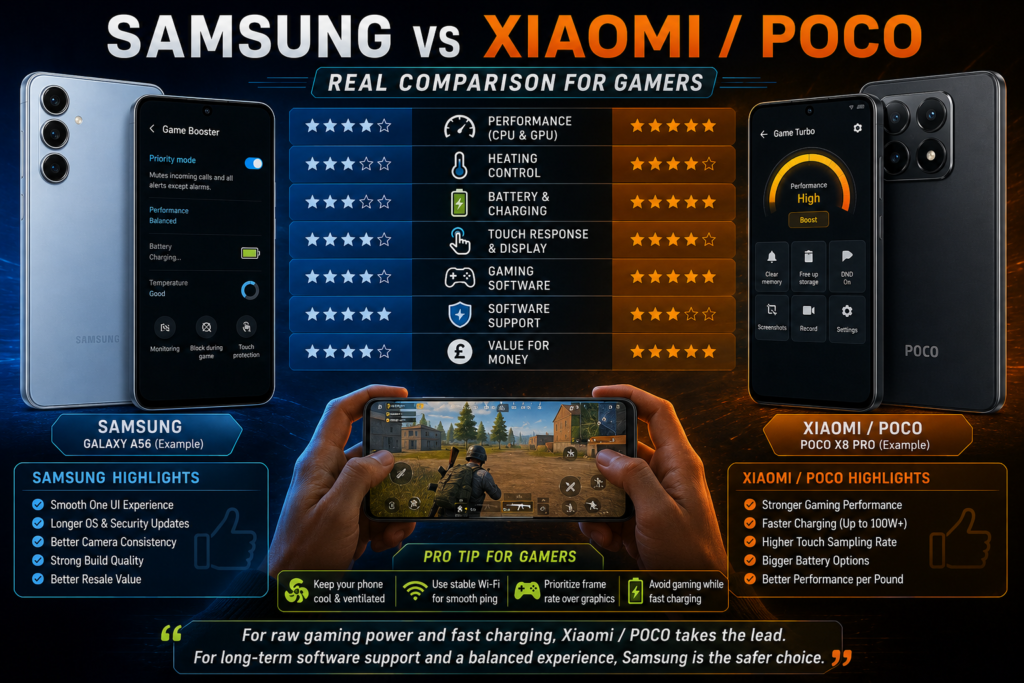
Samsung vs Xiaomi for Gaming at a Glance
| Category | Samsung Galaxy A-series | Redmi Note and POCO | Winner |
|---|---|---|---|
| Raw performance | Good to very good | Usually stronger for the price | Xiaomi/POCO |
| Sustained gaming | Depends heavily on model | Often prioritised on POCO models | Xiaomi/POCO |
| Display quality | Excellent | Excellent | Tie |
| Touch responsiveness | Good | More gaming-focused settings | Xiaomi/POCO |
| Charging speed | Usually more conservative | Frequently much faster | Xiaomi/POCO |
| Gaming software | Polished and simple | More customisable | Depends |
| Camera consistency | Generally stronger | Varies by model | Samsung |
| Software support | Excellent | Usually shorter | Samsung |
| Resale value | Usually stronger | Usually lower | Samsung |
| Performance per pound | Moderate to good | Often excellent | Xiaomi/POCO |
Important: This is a brand-level comparison. A Galaxy S-series flagship will easily outperform an entry-level Redmi, while a gaming-focused POCO may outperform a similarly priced Galaxy A-series device.
How We Compared the Two Brands
This guide focuses mainly on devices that UK buyers realistically compare:
Comparing a £1,000 flagship against a £250 budget phone would tell us very little. The meaningful question is what each brand offers at approximately the same price.
For current examples, Samsung’s newer Galaxy A57 starts at £529, while Xiaomi’s POCO X8 Pro Max starts at £399 on the UK store. Xiaomi also lists the Redmi Note 15 Pro+ 5G and POCO X8 Pro as current UK models.
We considered:
- Processor and GPU capability
- Behaviour during longer gaming sessions
- Display refresh rate and touch response
- Battery size and charging speed
- Gaming-mode features
- Software support
- UK pricing and availability
A phone can perform brilliantly during a five-minute benchmark and then slow down when it gets hot. That is why sustained performance matters more than one headline score.
⚠️ Do not compare phones using RAM alone
A phone with 12GB of RAM and a weak processor can perform worse in games than an 8GB phone with a stronger chipset.
For gaming, check the processor first, followed by cooling, storage technology and display responsiveness.
1. Display: Refresh Rate and Touch Response
Both Samsung and Xiaomi now provide high-refresh-rate AMOLED displays in their mid-range phones.
Samsung’s Galaxy A56, for example, uses a 6.7-inch 120Hz Super AMOLED display. Xiaomi’s Redmi Note 15 Pro+ uses a 6.83-inch 1.5K AMOLED screen with a refresh rate of up to 120Hz.
Both can provide:
- Smooth scrolling
- More fluid animations
- Better-looking high-frame-rate games
- Faster visual feedback than a standard 60Hz screen
However, refresh rate is only half the story.
Refresh rate versus touch sampling rate
Refresh rate describes how frequently the display updates the picture.
Touch sampling rate describes how often the screen checks for your finger input.
That difference matters in fast games such as:
- PUBG Mobile
- Call of Duty: Mobile
- Free Fire MAX
- Mobile Legends
- eFootball
Xiaomi lists touch sampling of up to 480Hz, with an instantaneous rate of up to 2560Hz in Game Turbo mode, for the Redmi Note 15 Pro+ 5G. That is clearly aimed at players who care about fast taps and swipes.
Samsung displays tend to be polished and visually consistent, but the Galaxy A-series is marketed more as an all-round range than a competitive gaming line.
Display score
Samsung: ⭐⭐⭐⭐☆
Xiaomi/POCO: ⭐⭐⭐⭐⭐
Winner for competitive touch response: Xiaomi/POCO
Winner for general screen quality: Tie
💡 Remember
A 120Hz screen does not automatically mean a game will run at 120 frames per second.
Actual frame rate still depends on the processor, game settings and whether the game supports that mode on your device.
2. Processor Performance Under Gaming Load
This is the most important category.
Samsung uses its own Exynos processors in several Galaxy A-series devices, while Xiaomi and POCO use a mixture of Snapdragon and MediaTek Dimensity chips.
The Galaxy A56 uses the Exynos 1580, while Xiaomi’s Redmi Note 15 Pro+ uses the Snapdragon 7s Gen 4. The newer POCO X8 Pro uses the Dimensity 8500-Ultra, and the POCO X8 Pro Max steps up to the more powerful Dimensity 9500s.
However, do not assume:
- Snapdragon always beats Exynos
- MediaTek is automatically weaker
- More RAM guarantees higher frame rates
- A newer phone is always faster
The exact chipset, cooling design and power tuning matter more than the brand printed on the box.
Why POCO frequently performs well
POCO’s strategy is usually straightforward:
Put as much processor performance as possible into the phone’s price.
The POCO X8 Pro Max, for example, is listed with:
- Dimensity 9500s
- LPDDR5X memory
- UFS 4.1 storage
- 1.5K 120Hz AMOLED display
- 8,500mAh battery
- 100W charging
Its UK starting price is currently listed from £399, although promotional prices can change.
Samsung generally spends more of the phone’s budget across the whole ownership experience:
- Camera processing
- Build quality
- Water resistance
- Software refinement
- Security features
- Longer updates
- Ecosystem integration
Processor score
Samsung Galaxy A-series: ⭐⭐⭐⭐☆
Redmi Note Pro series: ⭐⭐⭐⭐☆
POCO X/F series: ⭐⭐⭐⭐⭐
Winner for performance per pound: POCO
🎮 Which description sounds like you?
You play for twenty or thirty minutes occasionally
A recent Galaxy A-series phone should provide a good experience, particularly in PUBG Mobile, COD Mobile, Free Fire MAX and similar games.
You play for one or two hours most evenings
A performance-focused POCO is usually the more logical place to start because processor performance, cooling and battery capacity receive greater priority.
You mainly play demanding games
For titles such as Genshin Impact, compare the exact chipset and independent sustained-performance testing before buying. Brand reputation alone is not enough.
3. Heating and Thermal Throttling
A phone may feel extremely fast when you start playing and then become slower after fifteen or twenty minutes.
That is usually caused by thermal throttling.
When internal temperatures rise, the phone reduces processor and GPU performance to protect:
- The battery
- Internal components
- Long-term reliability
- The user’s hands
Possible symptoms include:
- Lower frame rates
- Sudden stutters
- Reduced display brightness
- Slower loading
- Faster battery drain
- An increasingly warm frame
Some older Exynos devices developed a poor reputation for heat, but it would be inaccurate to assume every modern Samsung phone has the same issue. Samsung specifically describes the Galaxy A56 as using a larger, improved cooling chamber intended to maintain performance when the device heats up.
POCO also markets its phones heavily around performance and extended gaming. That does not mean every POCO stays cold—powerful processors still generate heat—but gaming-focused models are usually designed with sustained load in mind.
Thermal score
Samsung: ⭐⭐⭐⭐☆
Redmi Note: ⭐⭐⭐⭐☆
POCO: ⭐⭐⭐⭐⭐
Likely winner at comparable prices: POCO
🔥 How to reduce gaming heat
- Remove a thick case during long sessions
- Avoid playing in direct sunlight
- Lower screen brightness slightly
- Do not play while fast charging
- Use stable Wi-Fi rather than weak mobile data
- Prioritise frame rate over maximum graphics quality
A thick case can sometimes make a larger difference to comfort than the small thermal gap between two chipsets. Heat and heavy gaming sessions also drain battery faster than most people expect — I broke down the settings that actually help in my guide on Android battery
saving tips.
4. RAM Management and Multitasking
Both brands offer virtual-memory features:
- Samsung calls it RAM Plus
- Xiaomi calls it Memory Extension
These features use part of the internal storage as virtual memory.
That sounds impressive, but it does not increase raw gaming power. Its main benefit is helping apps stay open in the background. Virtual RAM uses part of your internal storage though, so if your phone is already tight on space, it’s worth checking how much room you actually have free — something I covered in my guide on freeing up Android storage.
Virtual RAM does not provide:
- A stronger graphics processor
- Higher frame rates
- Faster rendering
- Additional physical memory bandwidth
Its main benefit is helping apps stay open in the background.
For example:
- Leave PUBG Mobile
- Check a WhatsApp message
- Return to the game
- Continue without reloading from the beginning
Samsung’s One UI tends to provide a predictable multitasking experience. Xiaomi’s HyperOS can also perform well, although its battery-management settings may sometimes need adjusting to prevent particular apps from closing in the background.
RAM-management score
Samsung: ⭐⭐⭐⭐⭐
Xiaomi: ⭐⭐⭐⭐☆
Winner: Samsung
⚠️ Should you enable the maximum memory extension?
Not automatically.
Internal storage is slower than physical RAM. Leave the feature at its default level unless apps frequently restart when you switch between them.
5. Battery Life and Charging
Gaming places a heavy load on:
- The CPU
- GPU
- Display
- Speakers
- Wi-Fi or mobile data
- Touch controller
- Background system services
That means charging speed and battery size can noticeably affect the ownership experience.
Samsung’s Galaxy A56 uses a 5,000mAh battery with 45W charging. Newer Xiaomi models go much further: the Redmi Note 15 Pro+ carries a 6,500mAh battery with 100W charging, while the POCO X8 Pro Max is listed with an 8,500mAh battery and 100W HyperCharge.
This is a major practical advantage for frequent gamers.
Imagine both phones have dropped below 30% after a long session. A Xiaomi or POCO model with 100W charging can potentially return to a useful charge much faster than a 45W Samsung, although actual charging speed depends on heat, battery percentage and whether the required charger is included.
Xiaomi states that the POCO X8 Pro Max does not include a power adapter in the box, recommending an official 100W-or-higher adapter. UK buyers should always check what is included before ordering.
Battery and charging score
| Area | Samsung | Xiaomi/POCO |
|---|---|---|
| Battery capacity | ⭐⭐⭐⭐☆ | ⭐⭐⭐⭐⭐ |
| Charging speed | ⭐⭐⭐☆☆ | ⭐⭐⭐⭐⭐ |
| Quick top-ups | ⭐⭐⭐☆☆ | ⭐⭐⭐⭐⭐ |
| Conservative charging approach | ⭐⭐⭐⭐⭐ | ⭐⭐⭐⭐☆ |
Winner: Xiaomi/POCO
⚡ Charging reality check
A phone does not maintain its advertised maximum wattage throughout the entire charging cycle.
Charging normally slows as the battery becomes fuller or warmer.
6. Samsung Game Booster vs Xiaomi Game Turbo
Both companies include dedicated gaming software.
Samsung Game Booster
Samsung’s Game Booster is integrated into its wider Gaming Hub experience.
Depending on the model and software version, it can provide:
- Notification blocking
- Performance monitoring
- Screen recording
- Screenshot shortcuts
- Touch-protection controls
- Temperature information
- Battery information
- Game-priority settings
Its main advantage is polish. It feels like part of One UI rather than a separate utility.
Xiaomi Game Turbo
Game Turbo tends to provide more gamer-oriented customisation.
Features can include:
- Individual profiles for each game
- Touch-response adjustment
- Notification blocking
- Quick app access
- Screen recording
- Performance modes
- Background-app controls
- Visual and audio options
The available functions vary by phone and HyperOS version.
Gaming software score
Samsung Game Booster: ⭐⭐⭐⭐☆
Xiaomi Game Turbo: ⭐⭐⭐⭐⭐
Best for simplicity: Samsung
Best for customisation: Xiaomi
💡 Gaming modes cannot fix weak hardware
These tools can reduce interruptions and limit unnecessary background activity, but they cannot turn an entry-level processor into a flagship chip.
7. One UI vs HyperOS
Samsung starts winning back points when gaming is considered as only one part of phone ownership.
Why UK buyers may prefer One UI
Samsung’s One UI is generally known for:
- Consistent navigation
- Strong ecosystem integration
- Good accessibility features
- Reliable multitasking
- Long software support
- Samsung Knox security
- Broad after-sales support
Samsung provides up to six generations of operating-system upgrades and six years of security updates for recent Galaxy A models such as the A56. Samsung has also continued that long-support approach with the newer Galaxy A57 and A37.
This matters if you keep your phone for four, five or six years.
Why gamers may prefer HyperOS
Xiaomi’s HyperOS offers:
- Extensive customisation
- Game Turbo controls
- Aggressive performance settings
- Many built-in features
- Strong integration with Xiaomi accessories
The downside is that the experience can vary by model and software region. Some buyers may also prefer Samsung’s more restrained presentation and longer update commitment.
Software score
Samsung One UI: ⭐⭐⭐⭐⭐
Xiaomi HyperOS: ⭐⭐⭐⭐☆
Winner: Samsung
8. UK Price and Value
Unlike Pakistan, UK buyers do not need to think about PTA approval or unofficial registration. However, they should still check:
- Whether the phone is a UK model
- Whether it has a UK warranty
- Whether the charger is included
- Whether a marketplace seller is authorised
- Whether the phone is new, imported or refurbished
Current official pricing shows how different the two strategies are.
Samsung launched the Galaxy A56 256GB at an RRP of £499. The newer Galaxy A57 starts at £529.
Xiaomi currently lists:
- POCO X8 Pro Max from £399
- POCO X7 Pro 12GB/512GB at £349 in an earlier official listing
- Redmi Note 14 Pro+ from £399 at launch
- POCO phones across several lower price points
Prices and promotional discounts can change frequently, so always check the live retailer price before publishing or buying.
What this means
At roughly £400–£550:
Samsung usually gives you:
- Longer software support
- A polished interface
- Stronger brand recognition
- Better resale prospects
- More balanced camera performance
- A broader UK retail presence
Xiaomi or POCO usually gives you:
- More powerful gaming hardware
- Larger batteries
- Faster charging
- More storage or RAM for the price
- More gaming-focused software
9. Which Brand Suits Different Games?
Performance varies by model, temperature and software version, but the following table provides a sensible buying guide.
| Game | Samsung Galaxy A-series | Redmi Note Pro | POCO X/F |
|---|---|---|---|
| Free Fire MAX | Excellent | Excellent | Excellent |
| PUBG Mobile | Good to very good | Very good | Often excellent |
| COD Mobile | Good to very good | Very good | Often excellent |
| Mobile Legends | Excellent | Excellent | Excellent |
| eFootball | Very good | Very good | Excellent |
| Genshin Impact | Model-dependent | Model-dependent | Usually strongest for the money |
| Honkai: Star Rail | Model-dependent | Good on stronger models | Better suited to higher settings |
The Xiaomi/POCO advantage becomes more relevant when:
- You play for long periods
- You use higher frame-rate settings
- You play demanding games
- You need quick charging between sessions
- Gaming is your main reason for buying the phone
10. Which Phone Should You Buy?
Choose Xiaomi or POCO if:
✅ Gaming is your main priority
✅ You want the strongest performance for your budget
✅ You play for long sessions
✅ Fast charging matters
✅ You like detailed gaming controls
✅ You replace your phone every two or three years
Best suited to:
- PUBG Mobile players
- COD Mobile players
- Free Fire MAX players
- Genshin Impact players
- Students seeking maximum specifications
- Buyers prioritising performance over camera refinement
Choose Samsung if:
✅ Gaming is only one part of how you use your phone
✅ You care about cameras and everyday reliability
✅ You want longer software support
✅ You prefer a more polished interface
✅ You use other Samsung products
✅ You plan to keep your phone for several years
Best suited to:
- Casual and moderate gamers
- Camera-focused users
- Long-term buyers
- Galaxy Watch or Galaxy Buds owners
- People who value stability over maximum benchmark performance
Find Your Winner: 30-Second Buyer Quiz
Give one point to Samsung or Xiaomi for each statement.
1. I play demanding games for more than one hour a day.
Xiaomi +1
2. I normally keep a phone for at least four years.
Samsung +1
3. I need rapid charging between gaming sessions.
Xiaomi +1
4. Camera quality matters as much as gaming.
Samsung +1
5. I want the most powerful processor available for my money.
Xiaomi +1
6. I prefer polished, predictable software.
Samsung +1
7. I enjoy adjusting touch and performance settings.
Xiaomi +1
8. Resale value matters to me.
Samsung +1
Your result
More Xiaomi points: Start with a Redmi Note Pro or POCO X/F-series device.
More Samsung points: Start with a recent Galaxy A-series device.
Equal score: Compare the exact chipsets, prices and update policies of the two phones on your shortlist.
Common Buying Mistakes
Comparing only RAM
More RAM does not automatically mean better gaming.
Assuming every Snapdragon chip is powerful
Snapdragon includes entry-level, mid-range and flagship processors.
Ignoring cooling
A processor that looks powerful on paper may slow down during longer sessions.
Buying an imported model without checking bands and warranty
An imported phone may have limited UK warranty support or different network compatibility.
Forgetting to check the charger
Some phones support very fast charging but do not include the required adapter.
Playing while charging
Gaming and rapid charging at the same time can create additional heat.
Choosing maximum graphics instead of stable frame rate
For competitive games, stable performance is usually more useful than better shadows and textures.
Final Verdict: Samsung or Xiaomi?
If someone gave me £400 and said:
“Buy the strongest gaming phone you can find.”
I would begin with POCO’s X-series or F-series.
POCO typically directs more of the phone’s cost towards:
- Processor performance
- Cooling
- Battery capacity
- Charging speed
- Gaming features
But if the same person said:
“I need one dependable phone for gaming, photography, work and the next five years.”
I would give Samsung’s Galaxy A-series much stronger consideration.
Samsung generally offers:
- Longer software support
- A more refined interface
- Better ecosystem integration
- Stronger resale value
- A more balanced ownership experience
The simplest answer
Xiaomi and POCO usually provide more gaming performance per pound. Samsung usually provides the better long-term all-round experience.
Neither brand wins every category.
Choose Xiaomi or POCO when gaming performance today is the priority.
Choose Samsung when software support, polish and long-term ownership matter just as much.
Frequently Asked Questions
Is Xiaomi better than Samsung for PUBG Mobile?
At comparable mid-range UK prices, gaming-focused POCO and Redmi devices frequently provide stronger processor, battery and charging specifications. However, the exact model matters more than the brand name.
Does Samsung overheat more than Xiaomi?
Some older Exynos phones developed a poor thermal reputation, but newer Samsung models include improved cooling. Powerful Xiaomi and POCO phones can also become warm when running demanding games at high frame rates.
Is POCO better than Redmi for gaming?
Usually, yes. POCO tends to prioritise processor performance and battery hardware, while Redmi Note devices aim for a more balanced combination of camera, design and performance.
Is 12GB of RAM necessary for mobile gaming?
No. For most Android games, 8GB of physical RAM is sufficient when paired with a strong processor. More RAM is useful for multitasking but does not compensate for a weak GPU.
Does virtual RAM increase FPS?
No. Virtual memory may reduce app reloading, but it does not meaningfully increase gaming frame rates.
Which brand offers longer software support?
Samsung offers up to six generations of operating-system upgrades and long-term security support on newer Galaxy A-series models.
Author bio
About the author: The author writes practical Android buying guides based on hands-on use, official specifications and real-world performance factors. Their work focuses on helping everyday buyers understand which features genuinely affect gaming, battery life and long-term ownership rather than relying only on marketing claims.