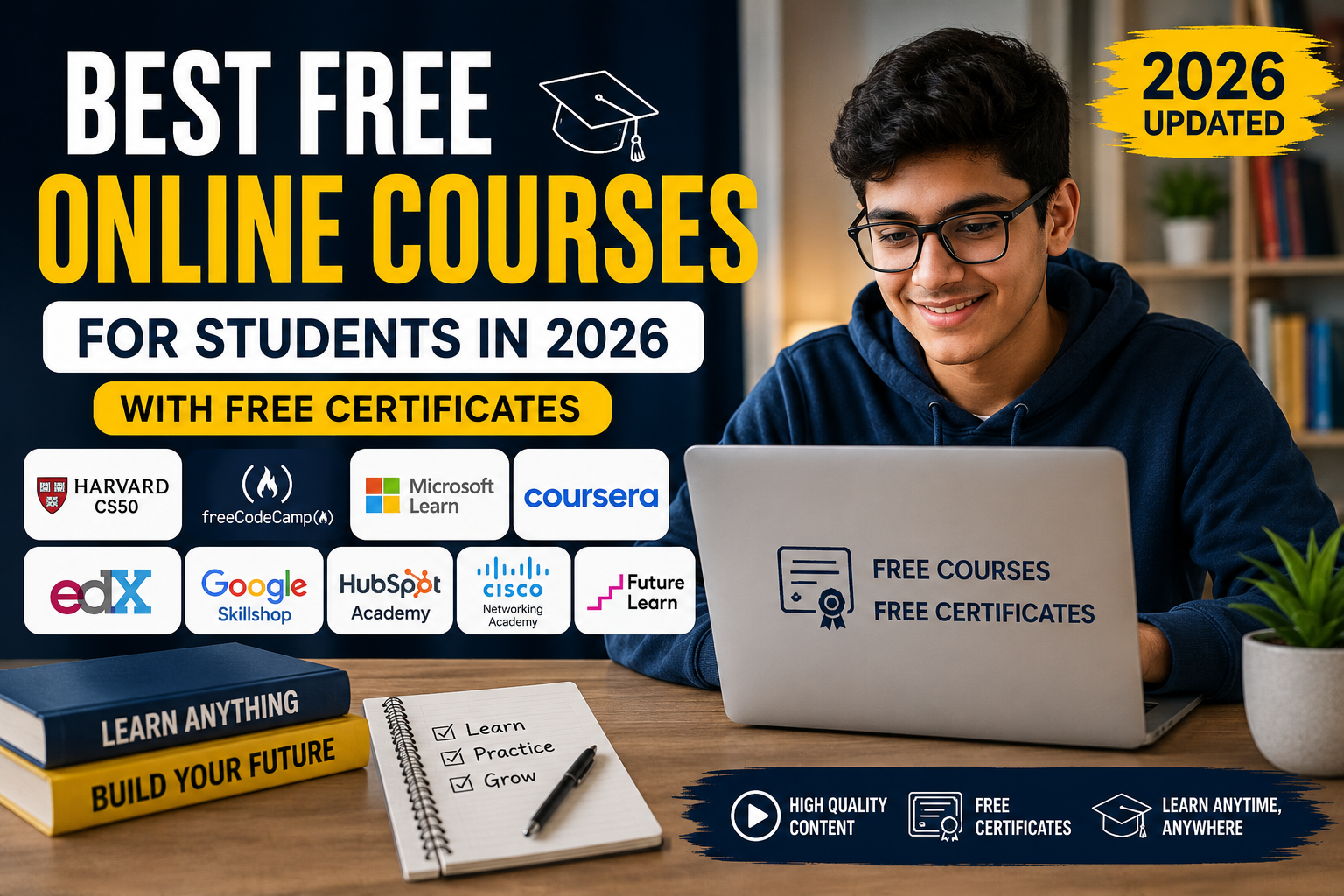
Best Free Online Courses for Students in 2026 (With Free Certificates)
A few years ago, I believed that learning something valuable online always meant paying for an expensive course. Every time I searched for a skill I wanted to learn, whether it was programming, digital marketing, or AI, I was greeted with courses costing hundreds of dollars.
As a student, that wasn’t realistic.
Eventually, I discovered that some of the world’s best universities and technology companies offer genuinely high-quality courses for free. The only challenge was knowing which platforms were actually worth my time.
Some websites advertise “free courses” but lock everything useful behind a paywall. Others provide amazing learning material but no certificate. A few offer both excellent content and a free certificate if you complete the course.
After comparing dozens of learning platforms, these are the ones I would confidently recommend to students in 2026.
Quick Comparison
| Platform | Free Courses | Free Certificate | Best For |
|---|---|---|---|
| Harvard CS50 | ✅ | ✅ (CS50 Certificate) | Computer Science |
| freeCodeCamp | ✅ | ✅ | Programming & Web Development |
| Microsoft Learn | ✅ | ❌ | Microsoft Technologies |
| Coursera | ✅ (Audit) | Limited | University Courses |
| edX | ✅ (Audit) | Usually Paid | University Learning |
| FutureLearn | ✅ (Selected Courses) | Limited | General Skills |
| Google Skillshop | ✅ | ✅ | Google Products |
| HubSpot Academy | ✅ | ✅ | Digital Marketing |
| Cisco Networking Academy | ✅ | Some Courses | Networking & Cybersecurity |
1. Harvard CS50
Best for: Computer Science
If you’re studying Computer Science—or planning to—Harvard’s CS50 should be one of your first choices.
Unlike many beginner courses that only teach syntax, CS50 teaches you how programmers think.
You’ll learn topics such as:
- Programming fundamentals
- Algorithms
- Data structures
- Memory management
- Python
- SQL
- HTML
- CSS
- JavaScript
The lectures are engaging, and the assignments push you to solve problems independently instead of simply copying code.
Pros
- Completely free
- World-class lectures
- Excellent assignments
- Great foundation
Cons
- Challenging for complete beginners
2. freeCodeCamp
Best for: Web Development
freeCodeCamp has helped millions of people start coding.
Instead of watching long videos, you immediately begin writing code inside your browser.
Learning paths include:
- HTML
- CSS
- JavaScript
- React
- Python
- APIs
- Databases
- Data Analysis
One thing I appreciate is that every section ends with projects rather than just quizzes.
Building something yourself teaches far more than simply watching another tutorial.
Pros
- 100% free
- Certificates included
- Browser-based coding
- Huge community
Cons
- Some projects become challenging later
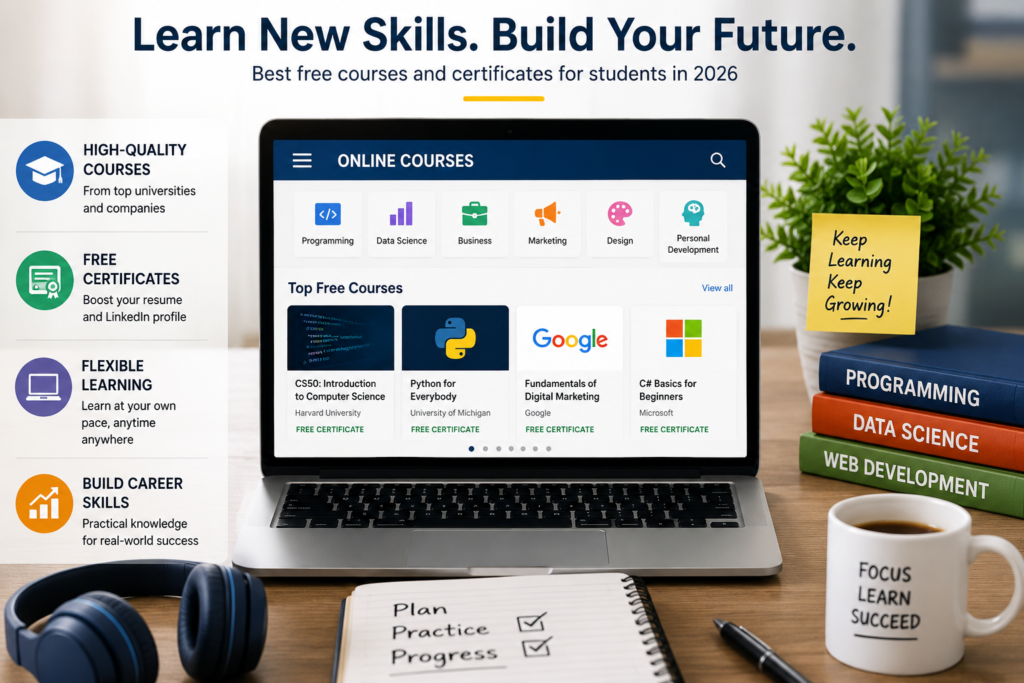
3. Microsoft Learn
Best for: C#, .NET, Azure
If you want to work with Microsoft technologies, this is the official place to learn.
Topics include:
- C#
- .NET
- Azure
- AI
- GitHub
- Power Platform
- Security
The lessons are organized into small modules, making it easier to learn consistently.
Unlike random YouTube tutorials, Microsoft Learn stays updated with the latest versions.
Pros
- Official Microsoft content
- Completely free
- Excellent documentation
Cons
- No free certificate for every learning path
Official Website: https://learn.microsoft.com/
4. Coursera
Best for: University Courses
Coursera partners with universities like:
- Stanford
- Yale
- IBM
- Meta
Many courses can be audited for free.
That means you can watch the lectures and learn the material without paying.
The certificate usually requires payment unless the course specifically offers a free certificate or you qualify for financial aid.
Pros
- Excellent instructors
- University-quality material
- Huge course library
Cons
- Certificates usually require payment
5. edX
Best for: Academic Learning
edX is another platform offering university-level education.
You’ll find courses from institutions like:
- Harvard
- MIT
- Berkeley
- IBM
Topics include:
- Programming
- AI
- Cybersecurity
- Mathematics
- Engineering
- Business
Most courses are free to audit.
Pros
- High-quality content
- University instructors
- Strong technical courses
Cons
- Certificates are usually paid
6. Google Skillshop
Best for: Google Tools
If you’re interested in:
- Google Ads
- Google Analytics
- Google Marketing Platform
Skillshop is one of the best places to learn directly from Google.
Many courses also provide free certificates after passing the assessments.
Pros
- Official Google training
- Free certifications
- Beginner-friendly
Cons
- Focused mainly on Google products
7. HubSpot Academy
Best for: Digital Marketing
HubSpot Academy is one of the few platforms where the free courses feel surprisingly premium.
Popular topics include:
- Content Marketing
- SEO
- Email Marketing
- Social Media
- Sales
- CRM
The certificates are recognized by many employers.
Pros
- High-quality videos
- Excellent certificates
- Easy to follow
Cons
- Mainly marketing-related
8. Cisco Networking Academy
Best for: Networking & Cybersecurity
Students interested in networking should definitely explore Cisco Networking Academy.
Popular subjects include:
- Networking Basics
- Cybersecurity
- Linux
- Python
- Packet Tracer
Many beginner courses are completely free.
Pros
- Industry-recognized
- Practical labs
- Strong networking content
Cons
- Advanced certifications may require exams
9. FutureLearn
Best for: General Skills
FutureLearn offers courses from universities and organizations around the world.
Topics include:
- Healthcare
- Business
- Technology
- Psychology
- Education
- Leadership
Many introductory courses are available for free, though certificates often require payment.
Pros
- University partners
- Wide variety
- Easy-to-follow lessons
Cons
- Certificates usually paid
Which Platform Should You Choose?
If you’re a Computer Science student
Start with:
- Harvard CS50
- freeCodeCamp
- Microsoft Learn
If you want a programming job
Use:
- freeCodeCamp
- CS50
- Microsoft Learn
- Build projects on GitHub
If you want digital marketing skills
Choose:
- HubSpot Academy
- Google Skillshop
If you want university-level education
Choose:
- Coursera
- edX
- FutureLearn
Common Mistakes Students Make
Trying Too Many Courses
Don’t enroll in ten courses at once.
Complete one before starting another.
Watching Without Practicing
Programming, design, and marketing all require practice.
Watching videos alone won’t build real skills.
Collecting Certificates
A certificate looks nice on LinkedIn.
A portfolio project impresses employers much more.
Build something with what you learn.
Giving Up Too Early
Many students quit after the first difficult assignment.
Every platform becomes harder after the beginner lessons.
That’s completely normal.
Internal Resources You May Find Helpful
If you’re interested in improving your technical skills, you may also like these guides on ByteGuideVX:
- Best Websites to Learn Coding for Free in 2026
- Best Free Apps for Students in 2026
- W3Schools: Is It Good for Learning Programming?
These articles can help you choose the right learning platform and productivity tools for your studies.
Frequently Asked Questions
Which website offers the best free programming course?
For most beginners, freeCodeCamp is one of the best free options. If you want stronger computer science fundamentals, Harvard CS50 is an excellent choice.
Can I get free certificates?
Yes. Platforms like freeCodeCamp, Harvard CS50 (for eligible completions), HubSpot Academy, and Google Skillshop offer free certificates for selected courses.
Are free courses worth it?
Absolutely. Many free courses are created by universities and major technology companies. The value depends more on how much you practice than on how much you pay.
Can I get a job after learning from free courses?
Free courses can help you build valuable skills, but employers usually look for practical experience as well. Building projects, contributing to GitHub, and creating a portfolio alongside your learning can significantly strengthen your job applications.
Final Thoughts
The internet has made high-quality education more accessible than ever. You no longer need an expensive subscription to learn valuable technical or professional skills.
Choose one platform that matches your goal, commit to finishing a course, and apply what you learn through real projects. Consistency will take you much further than collecting dozens of unfinished courses.
Whether you’re learning programming, cloud computing, digital marketing, or cybersecurity, the resources above provide an excellent starting point without putting pressure on your budget.